
A company is the people in it. Here is the filter we run everyone through, including ourselves.
CAHUILLA, Calif. — There is a version of this article that lists five nice words and tells you we believe in them. That article is worthless, and you have read it a hundred times on a hundred contractor websites.
Here is the version that’s actually true: a construction company is not equipment, and it is not a logo. It is a conglomeration of people who came together to build something. Whatever we are going to be, we will be because of who is standing on the jobsite. That is not a sentiment. It is the constraint the entire business runs inside.
Which means the most important work we do is not pouring concrete. It’s deciding who gets to pour it with us.
Three questions before anything else
Every person we consider has to clear three gates, in this order:
Do they get it? Do they understand what this company is for, who we serve, and why remote tribal work is different from a strip mall in the suburbs? If someone doesn’t grasp the mission, everything downstream is just a job to them.
Do they want it? Not “will they accept the offer.” Do they have the drive to do this specific hard thing, in these specific hard places, when it is cold and far from home and the delivery truck is two days late?
Do they have the capacity to do it? Can they actually perform the work the skill, the license, the experience, the physical and mental capacity for it?
Miss any one of those and the answer is no. We’ve learned that hiring someone who fails one gate and hoping the other two carry them is a decision you pay for later, on someone else’s project, with your name on it.
The three values that define how we operate
Past the gates, five values do the rest of the filtering. The first three describe our character how we show up, and what we’re made of when a job goes sideways.
Sovereignty
The name of the company is also its first value, and it works in two directions.
Outward, it means respect for the independence and authority of the nations we serve. When we come onto tribal land, we are guests of a government. We are not there to explain to a community how things ought to be done. We listen first. We take direction from the people who have been stewarding that place far longer than our company has existed. Partner, not outsider and the difference shows up in the first meeting, not the closeout.
Inward, it means the same respect for the people who work here. We hire adults and we let them act like it. If you’re running a crew, you’re running it. Autonomy is not a perk we grant; it’s the operating assumption, and it’s why good people stay.
Adaptability
We work in places where the plan changes. Weather closes a window. A ferry doesn’t run. A material lead time doubles. A subsurface condition shows up that nobody’s survey caught.
The company that survives is the one that can pivot without losing momentum. So we hire for the instinct that treats a changed condition as a problem to solve today rather than a reason to stop and wait for instructions. Forward, regardless of conditions. That’s the whole value.
Grit
Pure perseverance until the objective is complete.
Obstacles sharpen the people who work here; they don’t stop them. We finish what we start, and we hold to a simple standard: nothing is good until it’s done. Ninety percent complete is not a status, it’s an unfinished building, and a community can’t move into it.
The two values we actually measure
The first three describe who we are. The last two are a management tool, and
we use them out loud.
Attitude is positive, accountable, and solution-focused. Zero tolerance for excuses, ego, and complaining. Not because we want a cheerful jobsite because those three things are contagious, and a crew that catches them stops being able to do hard work in hard places.
Performance is delivering results and doing what you said you’d do. Holding a high standard for quality and taking pride in the finished product. Not effort.
Outcome.
We plot both. Attitude on the vertical, performance on the horizontal, and
everybody lands somewhere on the grid.
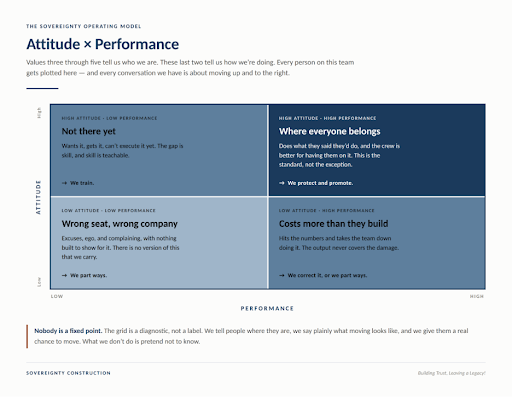
Figure — the attitude and performance grid used in every review conversation.
The goal is simple and it isn’t a secret from anyone who works here: everybody moves toward the top right. High attitude, high performance. That’s the standard, not the exception.
The other three quadrants each get a different response. Great attitude but not performing yet means the gap is skill, and skill is teachable, so we train. Performing but poisoning the crew is the one people are most tempted to tolerate, because the numbers look fine; we don’t tolerate it, because the output never covers the damage. And the bottom left isn’t a performance problem at all. It’s a fit problem, and the honest thing is to say so early rather than let someone spend two years in the wrong place.
What makes the grid work is that it’s a diagnostic, not a label. Nobody’s position is permanent. We tell people where they are, we say plainly what moving would look like, and we give them a real chance to move. What we don’t do is know and pretend not to.
Why we’re publishing this
Two reasons.
If you’re thinking about working here, you should know exactly what you’re walking into before you apply. This is the standard. It doesn’t relax on hard projects, hard projects are where it gets used.
And if you’re an owner deciding whether to hire us, this is who shows up on your site. Bonding capacity and license numbers tell you we’re qualified. This tells you what your project superintendent is going to be like at 6 a.m. on day forty, when it’s going badly.
That’s the part most contractors won’t put in writing. We just did.
